PARKER SOLAR PROBE
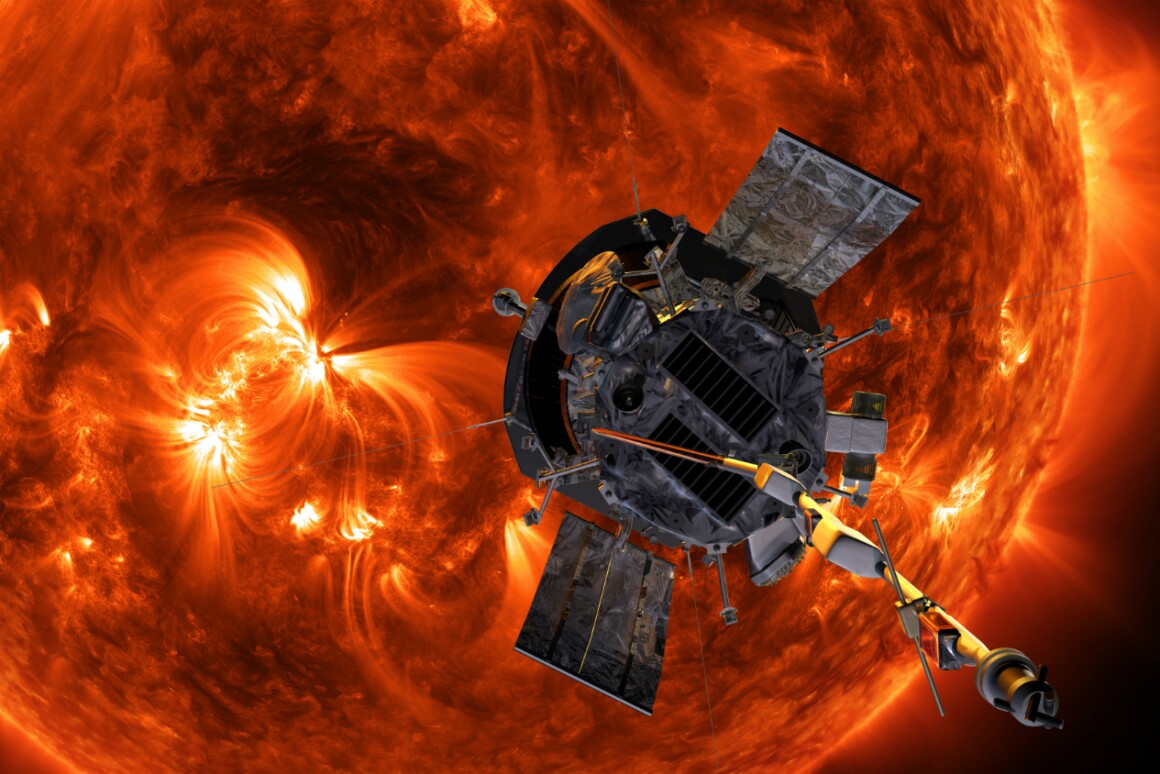
A MISSON TO TOUCH THE SUN
- NASA's Parker Solar Probe mission will revolutionize our understanding of the sun.
- Parker Solar Probe will provide new data on solar activity and make critical contributions to our ability to forecast major space-weather events that impact life on Earth.
- The primary science goals for the mission are to trace the flow of energy and understand the heating of the solar corona and to explore what accelerates the solar wind.
- Parker Solar Probe provides a statistical survey of the outer corona.


LAUNCH :
Launch: August 12, 2018 at 3:31 a.m. EDT (7:31 UTC)
Max. Launch C3 : 154 km2/s2
Launch Vehicle: Delta IV-Heavy with Upper Stage


JOURNEY TO THE SUN :
Parker Solar Probe will swoop to within 4 million miles of the sun's surface, facing heat and radiation like no spacecraft before it.
To get there, it takes an innovative route.
Parker Solar Probe will swoop to within 4 million miles of the sun's surface, facing heat and radiation like no spacecraft before it.
To get there, it takes an innovative route.
Trajectory Design :
- Parker Solar Probe will use seven Venus flybys over nearly seven years to gradually shrink its orbit around the sun, coming as close as 3.83 million miles (and 6.16 million kilometers) to the sun, well within the orbit of Mercury and about seven times closer than any spacecraft has come before.
- Parker Solar Probe is a true mission of exploration; for example, the spacecraft will go close enough to the sun to watch the solar wind speed up from subsonic to supersonic, and it will fly through the birthplace of the highest-energy solar particles. Still, as with any great mission of discovery, Parker Solar Probe is likely to generate more questions than it answers.
- 24 Orbits
- 7 Venus gravity assist flybys
- Parker Solar Probe will use seven Venus flybys over nearly seven years to gradually shrink its orbit around the sun, coming as close as 3.83 million miles (and 6.16 million kilometers) to the sun, well within the orbit of Mercury and about seven times closer than any spacecraft has come before.
- Parker Solar Probe is a true mission of exploration; for example, the spacecraft will go close enough to the sun to watch the solar wind speed up from subsonic to supersonic, and it will fly through the birthplace of the highest-energy solar particles. Still, as with any great mission of discovery, Parker Solar Probe is likely to generate more questions than it answers.
- 24 Orbits
- 7 Venus gravity assist flybys
WHERE IS PARKER SOLAR PROBE?

- The plot below shows Parker Solar Probe's location and speed (relative to the Sun) as it conducts its science operations.
- The spacecraft is in a highly elliptical orbit around the Sun (the yellow dot at the center of the plot), reaching its aphelion during the course of the mission initially at Earth and eventually closing to the orbit of Venus.
- Parker Solar Probe will perform seven Venus flybys in order to more precisely set its trajectory toward the Sun; these flybys will slow the spacecraft down, instead of speeding it up, which is a more common use for planetary flybys.

Mission of India for Sun


 ADITIYA-L1 :
- Aditya-L1 is India's first mission to study the Sun.
- Aditya-L1 will be placed 1.5 million miles away from Earth.
- The satellite will be launched during 2019 – 2020
 ADITIYA-L1 :
 - Aditya-L1 is India's first mission to study the Sun.
- Aditya-L1 will be placed 1.5 million miles away from Earth.
- The satellite will be launched during 2019 – 2020


No comments:
Post a Comment